The December 2014 Dairy Proof run brought with it a significant amount of change, from the genetic base change to Lifetime Net Merit and TPI® formula updates. Take a look as Genex Sire Procurement Specialist, Morgan Kleibenstein helps you navigate through what it all means!
Genex released 18 new genomic Holstein sires, 14 hailing from the GENESIS Cooperative Herd. Take a look at some of these, and several of our daughter-proven sires, as Genex Sire Procurement Specialist, Jon Lantz walks you through the Holstein highlights!
Genex now boasts over 40 active elite genetic Jersey sires with:
• 19 sires ≥ +0.0 DPR
• 17 over ≥ 4.5 Productive Life
• 14 sires over +$450 CM
• 12 sires over +15.0 JUI™
• 11 sires ≥ +180 JPI™
• Unmatched pedigree diversity
Watch as Genex Sire Procurement Specialist, Scott Carson takes you into the Jersey Generation!

Monday, December 15, 2014

Thursday, October 23, 2014
New Genex Vans Feature Form and Function
I have heard lots of comments about the new Genex vans, so I
decided it was time to spend some time with Genex Territory Sales Manager (TSM),
Chris Kinnard, to find out first-hand what all of the talk was about. Chris was one of the first to change from a Ford
F-350 diesel truck to the new Dodge® ProMaster van. He has been using it since
June for his daily sales routes.
When I jumped into the passenger seat on the rainy, cold
October day, the first thing that struck me was the amount of visibility
afforded the driver and passenger. One sits up higher than in a truck, and the
angle of the windshield and front end of the van make for excellent range of
vision. Did I mention it was a windy day, near Lake Michigan? I was a little worried about how the higher
profile vehicle would handle in all of the wind, and while I was not the one
driving, it seemed to be about the same as the car I drove to meet Chris in.
While I am on the topic of appearance, it must be noted that
if you see one of these new vans, you will certainly not miss it. Its colors,
graphics and photos are indicative of Genex and the business we are in. It is
also advantageous that the wrap can be removed when we are ready to resell the
vans making them a blank canvas, and thus more attractive, to a perspective
buyer.
.JPG)
Function is another big plus for the new vans. I have watched TSMs work inside of the
trucks. They always had a stool to sit on as there was not enough room to stand
and work. Products were an afterthought and tucked away wherever they seemed to
fit among the semen tanks, and having a nice area to write out orders and
receipts wasn't even considered.

TSM Tim Lynch sits on a stool to fill orders in the old style truck.
When Chris opened the new van door, I could see all of those
problems had been addressed. Shelving on both sides of the back made product
display easy and tidy. Members and customers can now see what products they
might have been missing in their herd management program. In one of the
shelving units is an area that can be used as an office or desk to allow for
completion and organization of paperwork. Catalogs and flyers are neatly
displayed in another shelf towards the door. Space also abounds for
informational posters, sales flyers, customer features, etc.

TSM Chris Kinnard fills orders with plenty of space to move in his new van.
So now it’s time to talk money. In information from Chuck
Dallas, Vice President of Diversified Programs, Services and Process Management
for CRI, the Ford F-350 diesel trucks with the utility boxes on the back cost approximately
$10,000 more than the Dodge ProMaster vans. In addition, the vans use gasoline
which is cheaper than diesel, and they will realize an improvement of about
four to six miles per gallon in fuel consumption. All of this fiscal
responsibility sounds great to me, as our farm recently became Genex
Cooperative members!
The one concern many have of the vans will soon get its test.
How will they handle on winter roads? Living in Wisconsin, I’m pretty sure I
won’t have to wait all that long to see and hear the answer to that
question. I’ll keep you posted!
While I can certainly relate to the drivers’ love for their
trucks (In high school, I used to cut deals with my Dad to do extra barn chores
so I could take his new truck when I went out), after spending the day on a
route with Chris, I can see why the decision was made to convert our sales
fleet. As additional vans get on the road, they should prove to be more
economical and functional for the cooperative as well as the TSMs that drive
them.
------------------------------------------------------------------------------------------------------------

Author Brenda Brady is our Communications Specialist. Brenda graduated from the University of Wisconsin-River Falls with a degree in Agricultural Education. She went on to teach high school agriculture for 13 years. Brenda grew up on a small Registered Holstein farm in central Wisconsin and now farms with her husband and in-laws. They recently started a show herd for their children by purchasing a Registered Jersey calf.
Thursday, August 28, 2014
August 2014 Genex Proof Highlights
Grab some popcorn, sit back, relax and enjoy learning about the highlights of our exciting lineup!
Holstein Daughter-Proven Proof Highlights
Holstein Genomic-Proven Proof Highlights
Celebrating 25 Years of the GENESIS Cooperative Herd
Introducing the Ideal Commercial Cow (ICC$) Index
Jersey and Colored Breed Proof Highlights
Holstein Genomic-Proven Proof Highlights
Celebrating 25 Years of the GENESIS Cooperative Herd
Introducing the Ideal Commercial Cow (ICC$) Index
Jersey and Colored Breed Proof Highlights
Tuesday, August 12, 2014
Genex Influenced Bred Heifer Sale on Superior Livestock
Do you have a group of bred heifers you want to sell this fall? Did you breed them to Genex sires this spring? If so, you have the awesome opportunity to consign them to the Superior Select Replacement Female Auctions featuring Genex Influenced Bred Heifers on Thursday, October 23 and Thursday, November 20.

This fall, producers will see record prices for bred heifers. Buyers are willing to pay a premium for cattle that come from known and predictable genetics. By letting the Genex Cooperative and Superior Livestock relationship work for them, producers that have added value to their heifers by using Genex sires will have the opportunity to realize those premiums.
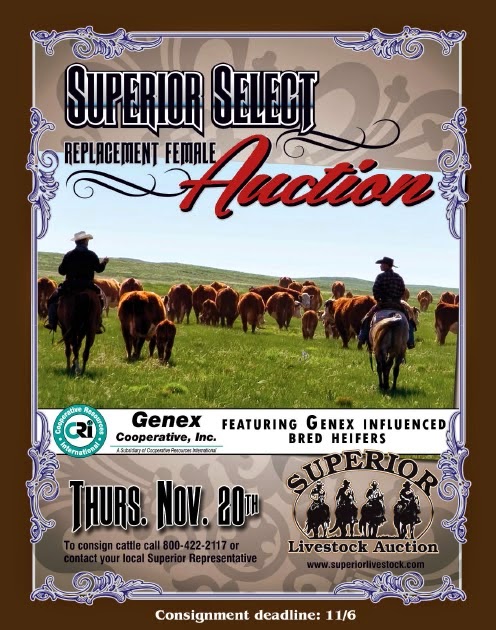
The consignment deadline for the October 23 sale is October 9 and November 6 for the November 20 sale. If you have any questions about the Genex Influenced sales or would like to consign cattle, contact Justin Hergenreder at jhergenreder@crinet.com or 303-349-5711.
--------------------------------------------------------------------------------------------------------------
 As Beef Large Herd Development Manager for Genex Cooperative, Justin Hergenreder, works with some of the cooperative's largest beef customers in the Southern and Western U.S. His goal is to help each producer find profitable genetic and reproductive solutions for their operations.
This fall, producers will see record prices for bred heifers. Buyers are willing to pay a premium for cattle that come from known and predictable genetics. By letting the Genex Cooperative and Superior Livestock relationship work for them, producers that have added value to their heifers by using Genex sires will have the opportunity to realize those premiums.
The consignment deadline for the October 23 sale is October 9 and November 6 for the November 20 sale. If you have any questions about the Genex Influenced sales or would like to consign cattle, contact Justin Hergenreder at jhergenreder@crinet.com or 303-349-5711.
--------------------------------------------------------------------------------------------------------------
Wednesday, July 9, 2014
The Effort Behind Beautiful Cow Photos
Great dairy cow photos don’t just happen; they are
created by a team and include lots of hard work! Growing up on and around
registered Holstein farms, picturing was no big deal. Didn’t everyone spend at
least one day a year primping their best cows and working tirelessly to get
them to stand just right?
Recently I had the chance to spend a day out of the
office working with a great team of individuals to capture images of several
dams and daughters of GENEX bulls. For one of our team members, it was her
first experience picturing. She also had limited dairy experience. This got me thinking
about what dairy cattle picturing must look like to the uninitiated, so I
grabbed a few photos of my own to help illustrate the process.
Dairy cattle picturing starts several days before
the photographer shows up. The cows must be tied up with a halter and full-body
clipped (similar to a buzz haircut on a human). This process also helps
introduce the cow to close contact with humans and a deviation from their
normal schedule. I wasn’t there the days they did this, so sorry, no photos!
Upon arrival on picturing day, the animal must again
be caught with a halter and washed to remove any bedding and/or manure from her
hair. A gentle soap is used to prevent skin irritation. She is then towel dried
to remove a majority of the water, followed by blow drying.

This might also be a good time to discuss the bucket
person. The bucket person’s job is super important, once the animal has been
washed. The bucket person watches the animals for any sign of defecation. If
the tail goes up, the bucket person must jump into action with the bucket to
catch the manure in a straw-lined bucket. He or she must then use the paper
towels to wipe away any remaining manure. This prevents any splatter from
getting the cow dirty again.
So, back to the primping, which we call fitting. The
next steps include taking small cordless clippers (just like your hair stylist
or barber uses) and clipping any hair that may have been missed, as well as the
udder, feet and legs. Sprays and powders are applied to make the whites white
and the blacks shine. Fly spray is also used to prevent those pesky insects
from bothering the cow while she is posed.

Then a leather show halter is put on, and the pretty
lady is ready for her photo shoot. Unfortunately cows don’t know how we want
them to pose, so here’s where the team becomes really important. One person is
needed to move each foot into position, someone holds the tail still, another
is required to make noise to get the animal to look in the right direction and
perk up her ears and of course, someone holds the halter. Some of the cows
respond well, and some are more of a challenge.


Every cow responds differently to the noise, so
there are plenty of tricks, such as a yummy dish of grain or a tiny stuffed cow
on a long pole (can be seen in the background).
Then there is the conductor of this well-tuned
orchestra, and we have a great one, Sarah Damrow. Sarah has a wonderful way of providing quick, concise instructions as
the animal is being posed to make her look her very best. It is Sarah’s
attention to detail that is the difference between success and failure. She is patient,
a terrific teacher and great at what she does!

And that’s how we get fabulous cow photos for use in advertisements, sire directories and other promotional pieces!
Tuesday, June 10, 2014
Stress and Embryonic Mortality
After you've gone through all the work of a synchronization and AI the last thing that you want to do is jeopardize any potential pregnancies. In a perfect world all the females would be AI bred out on summer pasture and there wouldn't be any need to move cattle to a new pasture or change feed, but in reality that is often not the case. Since most of us don't live in the perfect world, I suggest reading the article "Understanding the Effects of Stress and Embryonic Mortality in Cattle," by Sarah Fields and George Perry from South Dakota State University.

Understanding the critical embryonic development stages and how they are effected by stress can help you make more educated management decisions to achieve the most AI pregnancies possible.
------------------------------------------------------------------------------------------------------------------------------------

Here are the key take home points that I took from the article:
- Fertilization rates are between 90-100% when semen is present at the time ovulation occurs, pregnancy rates are generally closer to 60-70%
- Poor oocyte quality, disease, and chromosomal abnormality are all contributors to pregnancy loss, but heat and shipping stress can play a large role
- Embryo development begins on day 0, the day of standing estrus
- Between days 5-6 the embryo migrates from the oviduct (where fertilization occurs) into the uterine horn
- One days 15-17, the embryo sends a signal to the cow to tell her she is pregnant
- By day 42 the embryo has fully attached to the uterus
- Between days 5-42 the developing embryo is most susceptible to changes in the uterine environment caused by the release of stress hormones
- Research suggests that shipping cows between 5 and 42 days can cause around a 10% decrease in pregnancy rates
- Shipping cattle between 45 and 60 days can result in 5% embryo loss
Understanding the critical embryonic development stages and how they are effected by stress can help you make more educated management decisions to achieve the most AI pregnancies possible.
------------------------------------------------------------------------------------------------------------------------------------

Author,
Sarah Thorson, is our Beef Education Specialist. Sarah grew up in Eastern
Montana on her family's ranch. She is a graduate of Montana State
University and has been a member of the Genex team since 2004. Sarah
works closely with the Genex Beef Marketing Staff, providing training to
the cooperative's nearly 200 Independent Contractors. She also
provides Artificial Insemination training for Genex members and
customers and reproductive consulting.
Thursday, May 15, 2014
Late Spring at Genex Hawkeye West - Billings, MT
It's the middle of May, and it looks like maybe, just maybe, we are finally getting a taste of spring here in Billings, MT. As I've told you before, spring is the busiest time of year for us here at Genex Hawkeye West. I just wrapped up my 5th A.I. school in a little over 8 weeks. During those schools I trained over 70 beef producers from 7 states and Canada how to artificially inseminate their own cows. On the semen collection side of the business we had about 160 different bulls on collection at our peak. Things are slowly starting to calm down for the outside crew. This week more bulls have went home, destined for greener pastures and cows in heat, then have come to stay. Just as things slow down outside, they really start to heat up inside, because all that semen we have collected over the last couple of months needs to get into semen tanks all over the country. This means that phones have been ringing off the hook and shipper tanks have been flying out the door.
Earlier in the week I also took some time out to fulfill my self given title of "Office Beautification Manager" which basically means I plant, and subsequently water the flowers out front all summer!

From all of us at Genex Hawkeye West we hope you are having a great spring, enjoying some warmer weather after the long winter, and getting all the moisture that you need. Remember, if you haven't placed your semen order yet we are still offering some great spring specials. But don't delay in ordering to long, the specials are only good through May 31st!

 ------------------------------------------------------------------------------------------------------------------------------------
 |
| Semen storage tanks at Genex Hawkeye West. We store nearly 1 million units of semen. |
 |
| Shipper tanks packed and ready for UPS to pick them up and send them to their destination. |
Earlier in the week I also took some time out to fulfill my self given title of "Office Beautification Manager" which basically means I plant, and subsequently water the flowers out front all summer!
From all of us at Genex Hawkeye West we hope you are having a great spring, enjoying some warmer weather after the long winter, and getting all the moisture that you need. Remember, if you haven't placed your semen order yet we are still offering some great spring specials. But don't delay in ordering to long, the specials are only good through May 31st!
Author,
Sarah Thorson, is our Beef Education Manager. Sarah grew up in Eastern
Montana on her family's ranch. She is a graduate of Montana State
University and has been a member of the Genex team since 2004. Sarah
works closely with the Genex Beef Marketing Staff, providing training to
the cooperative's nearly 200 Independent Contractors. She also
provides Artificial Insemination training for Genex members and
customers and reproductive consulting.
Subscribe to:
Posts (Atom)