Thursday, May 21, 2015

Genex + Superior Livestock Auction = You Win!

By: Justin Hergenreder, Genex Beef Area Marketing Manager

During the heat of the beef breeding season, don’t forget to plan to take advantage of the relationship Genex has with Superior Livestock Auction. Any female bred to or sired by a Genex sire is eligible to be included in 1 of 3 special Superior sales this fall. 

This year's sales will take place on:
  • October 22
  • November 19
  • December 17

Last year A.I. bred females averaged well over $250 per head more, and demand for quality replacement females continues to rise. In addition to helping you command premiums for bred stock, Genex can assist you in marketing your feeder cattle through Superior.

Get in touch with Genex today, so we can help you locate a Superior representative near you. He or she will be thrilled to get involved in your program and show you how marketing with Superior is a great way to go. It’s hard to beat video of quality replacement females that have just been bred to top Genex sires out on green grass doing what they do best!
www.crinet.com or 1-888-333-1783

Tuesday, May 12, 2015

Ag Students Define Spirit of Agriculture

By Brooke Schultz, CRI

“An important percent of the current ag college graduates are returning to the farm,
which is another positive trend. However, a five-year projection indicates we will
be short over 15,000 ag graduates in the year 2020."

This was an eye-opening remark made by CEO Doug Wilson at the 2015 CRI annual meeting. While it’s nice to know agriculture college graduates return to their roots and what, more than likely, initiated their love for agriculture, you can’t help but focus on the latter half of that statement – the agriculture industry will, no doubt, suffer with a shortage of over 15,000 ag graduates.

With the decline of agriculture-related graduates, one thing has become evident for those who do choose to pursue that career path: they, must absolutely, without a doubt, be passionate about agriculture. The future of agriculture depends on hardworking, skilled, passionate young adults who are truly vested in arguably the most important industry worldwide. Keeping that in mind, our panel of judges selected four of 70 applicants to be awarded our first-ever CRI Collegiate Scholarship (next application period begins in January 2016).

Within the CRI Collegiate Scholarship application, students were asked to share what agriculture means to them and what lessons they learned from their agriculture involvement. With the answers we received, we know the future of agriculture looks bright. It was humbling to read about their passion for agriculture and what it has done for them, and we thought our four CRI Collegiate Scholarship recipients’ answers were too good not to share.

Between all four of their responses, they covered topics that define the essence of agriculture: a positive outlook, hard work, family and passion.


While some people may have a negative outlook on agriculture, scholarship award winner Gabryelle Gilliam from Washington, Kansas, proved with a little hard work and a positive mindset, agriculture can regain assurance and flourish as it has in the past. “I have learned that a positive outlook and influence is always needed in order to put a halt to some of the negativity agriculture has been facing. Our job as advocates is to get people to realize we are all the same, and we all rely on agriculture to survive."

People in all aspects of the agriculture industry know hard work and determination is what gets the job done, as Jeremy Davis of Bingham, Nebraska, illustrated. “Growing up on a ranch, I was given the experiences of actually working from a very young age. It was through these experiences that I learned work ethic and the mentality that if you are going to do it, do it the right way.” This is an important attitude to have in all aspects of your life, but especially in the agriculture field. With producers working extended hours, putting your all into your work the first time significantly decreases your chances of having to go back and do it again. And as we know, you do not have the time to backtrack! Giving minimal effort is not an option. You give it your all, all the time.

Agriculture is oftentimes associated with family and togetherness, and having a strong family connection helps you understand agriculture’s impact on both a local and global perspective. Madison Schafer from Goodhue, Minnesota, did an excellent job portraying the connection between family and agriculture by stating, “Family ties are what keep a farm going long after any other business would simply throw in the towel, and family is the structure that American agriculture has been built upon. I’ve learned what it means to dedicate yourself to something and really follow through with it to the end. I’ve also learned how important it is to celebrate the little things in life in the area of farming, because in the end: Farming isn’t just a way to make a living; it’s a way to make a life."

Can we all just take a moment to stop and re-read that last sentence? We couldn’t have said it better ourselves, Madison. This is the kind of outlook all agriculture graduates need to have. With future agriculturalists viewing their jobs not as something they need to do, but rather something they want to do, it gives us assurance that, despite the decreasing number of ag graduates, those who are pursuing agricultural degrees are passionate about it.

Speaking of passion, Gretta Binversie of Kiel, Wisconsin, explained how her passion for agriculture will propel her to succeed in agriculture. “The daily agriculture experience and contribution has elicited an attraction, love and passion I cannot simply give up. It presented an opportunity to know how it feels to work hard every single day while staying motivated and optimistic."

Seriously, with that kind of positive attitude, how can you not trust that these students will be a driving factor to what keeps agriculture alive? These are the kind of statements that prove it’s about quality, not quantity. Today’s agriculture students are dedicated, honorable young adults who will continue to make agriculture prosper. Maybe we don’t have the numbers, but we sure have the heart.

Saturday, May 9, 2015

Celebrating National Beef Month: Meet Andy Anderson

By Jenny Hanson, CRI

Beef cattle production is a strong part of the agricultural industry within the U.S. and throughout the world. From farmers and ranchers to processors, thousands of people play an integral role in the journey of beef from field to market. Also among those thousands of people are your Genex beef representatives. As we celebrate National Beef Month here on our blog as well as on Facebook and Twitter, I’d like to introduce you to several of our beef staff members. Today, let’s meet Andy Anderson of Emmett, Idaho.

Andy, what’s your background in the beef industry? I’ve been breeding cows for about 35 years. I got involved with the beef program at another A.I. stud in 1999 and came to Genex with the acquisition of that program in 2003. I worked as a Genex area beef representative (now called independent contractor) until 2006 and then came on board full time as a beef team leader. Today, I work with Genex independent contractors throughout Idaho, Utah and Nevada, supporting them as they serve Genex members and customers. I also organize teams for large breeding projects.

What would you tell someone considering Genex genetics and chute-side service? I feel we have the best beef lineup of the A.I. studs. We also have some of the best beef teams in the industry. We have people that know cattle both from the science sense and the cow sense. We have a variety of bulls with good, balanced numbers. Even more, our team members not only sell semen but can go in and breed cows. We provide chute-side service not only in small herds but also in large ones, breeding anywhere from 300 to 1,000 head or more. We also have the logistics – breeding barns and such – to get those breeding projects done efficiently.

Who’s your favorite Genex sire and why? Personally, my favorite bull would be 1AN01117 Connealy THUNDER, though with slow production he isn’t as readily available this year. I like Thunder because he works in so many different types of environments and in so many different herds. He sires cattle that are easy fleshing with great udders, good disposition and adequate growth. Mainly, he produces functional cattle.

Why are you ag proud? I am ag proud because I love working with cows and with other people who love their cows. Beef producers really care about the welfare of their cattle, and they always strive to improve their herd through each generation. Also, they always strive to best serve the end user, the consumer. The beef industry is a good industry to be involved in - with some of the best people in the world!

Thanks for joining Genex in celebrating National Beef Month. Watch for more beef facts, contests and features on our social media channels throughout the month!

Wednesday, May 6, 2015

It took a “Push,” but I’m sold!


By Brad Johnson, Genex

"I am confident Push works, and it
helped these two calves get up
and going" - Brad Johnson
My wife, Lindsay, and I have a small herd of Angus and Red Angus cows outside of Shawano, Wisconsin. Lindsay works in CRI Public Relations, and I am part of the Genex Beef Genetics division. Earlier this year, Lindsay brought home two tubes of Push™, a new protein and energy paste for calves that Genex is marketing within the U.S. Her mission was to get a photo of me giving a tube of Push to one of our calves for the upcoming advertising campaign of this new product. “No problem,” I told her.

We calve our heifers in February and the cows primarily in March and April. February in northeast Wisconsin is cold and snowy while March and April are cold, wet and muddy; neither time is ideal, that’s for sure. In fact, Lindsay has occasionally threatened to find a more patient A.I. technician so we can calve when it’s warmer! We build a few temporary calving pens in a pole shed and rotate cows in and pairs out. It works okay as long as we’re prepared.

This year Heifer #351 decided to calve outside on a cold, windy January day, about 10 days early! Upon noticing the newborn, I quickly shuffled the new pair to the shed, snapped on a CRI Calf Coat and began my normal new calf processing routine. I remembered the tube of Push stowed in the back pocket of my coveralls, so I gave it to the calf. Either it was too cold and windy for the photographer or two young kids were occupying her time, but we didn’t get a photo taken. In short order the calf was up and nursing and showing great vigor, so I felt pretty confident I’d gotten to the new calf in good time. About two weeks later, the calf’s ear tag fell completely out as her ears continued to get shorter and shorter from the frostbite she’d suffered. It was then I finally realized how much stress the calf had experienced. One tube of Push left. 

Heifer #312 spent several nights in the calving shed because the vet called her A.I. bred, but it soon became apparent she must have been bull bred. She was the last heifer to calve. I was tiring of 2:00 a.m. checks, so I was glad to see when she started calving at 10:00 p.m. I went back inside with intentions of giving her two hours. After the two hours it was clear I’d be assisting this delivery. Long story short, #312 delivered an 87 lb. bull calf with moderate help. Not the worst pull ever but stressful for the calf nonetheless. While Junior, the newborn calf, laid there sprawled out not doing much of anything, I again thought of the Push tube in my back pocket. He looked like a calf that could use a pick-me-up. Should I text the sleeping photographer to wake up, get dressed and come out into the cold to take our picture? What would any sane husband do? I opted to let Lindsay sleep. Fast forward 10 minutes and the calf was up drinking happily, thanks in large part to that tube of Push. I consider Junior a great advertisement for Push and for using proven A.I. sires on your heifers! Zero tubes of Push left. 

The next morning I called and ordered a box of Push. While these two examples aren’t the most difficult calving experiences I’ve ever seen, I am confident Push works, and it helped these two calves get up and going. The cost of a box of Push seems worth it, especially with $2.50+/lb. feeder calf prices and record sales of seedstock cattle.

I’m going to make sure I’ve always got a tube of Push in my back pocket when calving season rolls around. Now if we could just get that darn picture taken…

Push is an energizing paste for newborn or stressed calves. It gives calves the extra Push they need


Thursday, April 2, 2015

Freezin' For A Reason!

Mornings like this make me happy I have an office job!

But alas, sometimes I have to put on my big-girl boots and take the cold like a farm girl, especially if I wanted to see what our Dairy Regional Account Managers (DRAM) do on a daily basis.

I arrived at Genex DRAM, Derek Kolpack’s house for an early morning departure on his route to a few of his north eastern Wisconsin farms. I quickly discovered there is not a typical day, but I got a great look into some of what our Genex representatives have to offer dairy farmers. We made a couple of stops at potential customer's farms and spent time with Reproductive Program Senior Technician, Jeff Jahnke, in addition to doing a lot of observation and note taking.


The day made me take a step back, (literally-I had to step back a few times in the free stall barns to prevent a minor wardrobe malfunction!) and think about dairy farming as a whole.

Today's farmers are required to wear so many hats

First and foremost - they are an optimist!

Then they are scientists, veterinarians, accountants, truck drivers, nutritionists, general farm laborers and the list goes on...

Reasons for a farm's success or failure can be just as varied as the jobs a farmer must take on: feed quality, housing, animal health, environmental factors including weather, a particular cow's disposition, the humans the cattle encounter, soil conditions, and (insert your farm variables here).

Since the margin of error has become so narrow on today's farms many, if not most, farmers rely on a host of outside individuals to provide knowledge and expertise for their operation.

Genex recognized the need for farmers to have trained cattle reproductive experts available and expanded their lineup of staff. We not only offer individuals to breed cows and provide advice on which sires to use, we offer services such as: 

  • Visual heat detection
  • Chalk-and-walk heat detection
  • Synchronization protocol management
  • EAZI-BREED™ CIDR® management
  • Artificial Insemination
  • Breeding data input and analysis
  • Reproductive consulting services
  • Herd benchmarking
  • Corrective dairy mating through MAP
all with the intention of helping farmers reach their farm's goals.

After today, I am confident the only hat you need to wear when talking about cattle reproduction and genetics is a Genex one (if it is anything like today's temperature, I would recommend it being a warm fuzzy one too!). Let our staff deal with the constant change, worry, hassle and confusion of the industry, you can worry about the weather!
------------------------------------------------------------------------------------------------------------


Author Brenda Brady is our Communications Specialist.  Brenda graduated from the University of Wisconsin-River Falls with a degree in Agricultural Education.  She went on to teach high school agriculture for 13 years. Brenda grew up on a small Registered Holstein farm in central Wisconsin and now farms with her husband and in-laws.

Monday, March 9, 2015

The Results Are In!

We tested; we waited, and the results are here! So now what? How can we utilize the data reported from our very first DHI milk test? 

Since we already knew milk weights on test day, the item of immediate interest to me on the Sample Day and Lactation Report is Somatic Cell Count (SCC). SCC is composed primarily of leukocytes, or white blood cells, that are produced by the cow’s immune system to fight an inflammation in the mammary gland, or mastitis. Leukocytes increase as mammary system inflammation worsens, so a higher SCC indicates a higher level of bacterial infection. Because mastitis is tricky, it may be clinical (showing visible signs of infection) or subclinical (showing no visible signs of infection). Obviously the subclinical variety is what I am looking to the test to help me find for a couple of reasons. First, I want our cows to be healthy and comfortable. I can not treat what I can not see or do not know about. And then there are things called regulations and premiums. On the federal level, Grade A milk can not be sold with a SCC of over 750,000 cells/mL. While we are not in danger of that, it is always something dairy producers keep in the back of their mind. What we are excited about is most milk plants (including ours) will offer a premium for extremely low SCC levels as low SCC equals higher quality milk.


Of course, I am also interested in other data such as Fat and Protein percents on individual cows, days in milk (DIM) and reproduction status. All of these numbers, in combination with SCC, can assist in breeding and culling decisions in the future. In addition, I also look forward to the day, now that my Husband and In-laws know about it, that we can utilize breeding dates to conduct milk pregnancy tests

Woohoo - since it took me a while to publish this post, we tested again, and I convinced them to try the pregnancy tests on two of the cows we were wondering about. Two cows confirmed PG!! That was super simple, no extra work for us or the cows. You can bet we are doing that again. Look out AgSource, our 40 cows are going to set you right over the edge - you may have to hire another lab assistant for all of our samples! ;)

On the herd level, a Herd Summary report is generated and was also in the envelope. While the Milk Production section it is not too exciting on our current report with only one test date to plot on the charts and graphs, I look forward to seeing where we have been and where we are headed in terms of average test day milk, fat and protein, rolling herd average and peak milk trends. It is also interesting to see where we are as compared to the breed average. The back side is the Reproduction and Genetics section, along with the Inventory section. Data such as conception rates, service and pregnancy rates, DIM at first breeding and herd inventory is all available in easy to read, color-coded graphs.


Of course, this is just the tip of the iceberg in terms of what reports can be generated and data gleaned from the milk samples and reproductive data we supplied AgSource Cooperative Services. For a full listing of their DHI services, check out their website.

While our herd certainly has a way to go to get to my goals for it in terms of milk production and quality, we now have concrete numbers to base our decisions on. While it make take a little extra time milking on test day and scouring through the numbers, to me it is time well spent!
------------------------------------------------------------------------------------------------------------


Author Brenda Brady is our Communications Specialist.  Brenda graduated from the University of Wisconsin-River Falls with a degree in Agricultural Education.  She went on to teach high school agriculture for 13 years. Brenda grew up on a small Registered Holstein farm in central Wisconsin and now farms with her husband and in-laws.

Monday, February 16, 2015

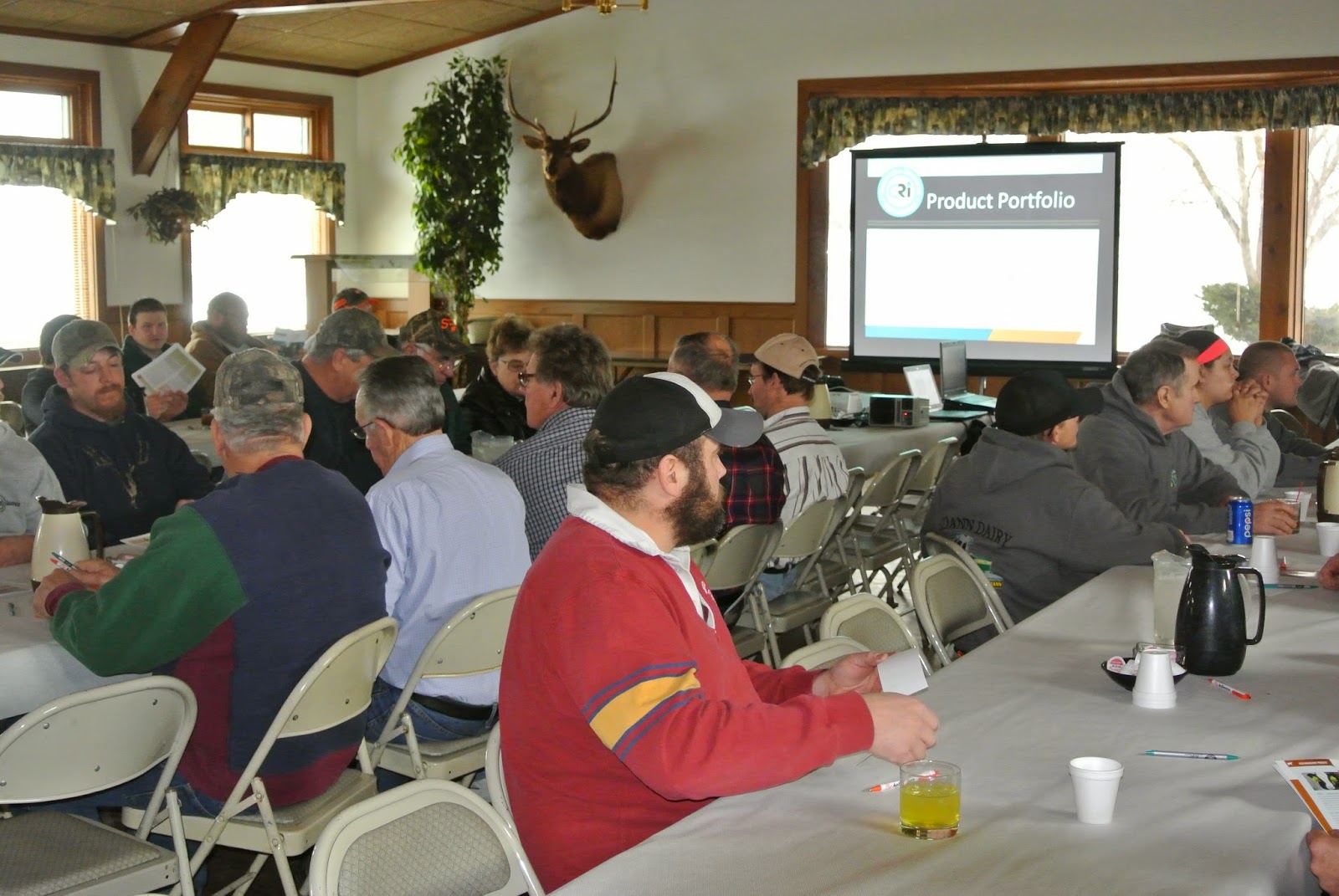
Eight Fabulous Reasons to Attend Your Genex Membership Appreciation Meeting

Last week I attended my first ever Genex Membership Appreciation Meeting. It was great getting to talk with so many dairy producers from northeastern Wisconsin. If you are a Genex member, ask your representative when and where your closest meeting is. You won’t regret going, I didn’t!

Eight Fabulous Reasons to Attend Your Genex Membership Appreciation Meeting


1)Door prizes
2


2)      Real conversations with beings other than cows


3)      Access to the newest flyers, sire summaries, calendars and other printed materials

4)      Receive inside information into the state of YOUR cooperative


5)      It’s a chance to get to town and away from the farm for a few hours
6

6)  Amazing food


7)      Learn about the latest and greatest products available from Genex

8)      Because it’s free!

What is your favorite reason for attending a Genex Membership Appreciation Meeting?

----------------------------------------------------------------------------------------------------------------


      Author Brenda Brady is our Communications Specialist.  Brenda graduated from the University of Wisconsin-River Falls with a degree in Agricultural Education.  She went on to teach high school agriculture for 13 years. Brenda grew up on a small Registered Holstein farm in central Wisconsin and now farms with her husband and in-laws.