Monday, June 27, 2016

My Dairy Devine Child Care Trip!

An important aspect of June Dairy Month is dairy education. So, today I spent some time at a cooperative child care (more about that later) asking three and four year olds dairy related questions. As a dairy farmer myself, I was elated to hear that every one of these energetic souls knew that milk came from a cow and cows eat grass, although one little girl said that was "ewww!"

I did learn that no matter how much personal experience I told them I had on the topic, they would not believe me when I told them chocolate milk is made, not produced by “brown, little cows.” They were also very adamant about their image of what a farmer looks like. One little girl, who had already stood and was now inching her way closer and closer to me said, “A farmer has brown hair.” This drew several nods. Then the little blonde girl sitting in the front who was very eager to answer every question added, “And he wears a blue hat,” which was followed a bit later by a quiet little boy who hadn’t said much during my question and answer session. With a wide grin he said, “And a farmer scoops up dirt!”


After the five intense minutes of questioning, I rewarded the kids by reading from a book about dairy farming. It was great to see their interested little faces watching every turn of the page and finishing the sentences before I could. The story time of my visit even intrigued a little boy who was playing with blocks and didn’t want anything to do with my earlier line of questions. He scooted right up next to my legs to get a really good look at each picture, noticing every little detail. I can tell you I was also super happy with the selection of accurate books about dairy farming my local public library carried.

As a side note-if you are ever looking for ways to improve ag literacy in your community, your local public library LOVES donations of ag-accurate books. I have done this with our FFA chapter as well as for a memorial of someone who cared deeply about agriculture. Our local library carries stickers to put in the front cover of the books with who the book is in memory of or who it was donated by. If you are having a hard time finding ag-accurate books, a good place to start is the American Farm Bureau Foundation for Agriculture. They have a great, searchable list for all ages of kids!

Being somewhat of a novice to group story time, I did make a giant mistake. I closed the book and attempted to move on to snack time, not realizing I had forgotten to say “the end.” Don’t worry, I had 10 three and four year olds who quickly and loudly reminded me!

Then came probably the most rewarding part of my visit, watching the kids devour, and ask for more, string cheese and chocolate milk. The fact that they liked this delicious and nutritious snack reminded me why dairy farming is so important, and renewed my faith in my husband’s chosen profession, even if we won’t see him until after 9:00 tonight for dinner!

Now for the super cool cooperative day care info. Since Cooperative Resources International (CRI) is a holding cooperative and two of its three subsidiaries are also cooperatives, CRI decided entering into a venture with two other local companies to form a cooperative child care center made sense. This unique business structure allows parent members to serve on the board of directors and vote as the need arises. I love that these companies saw a void in the community and decided a cooperative was the best way to address it!


Enjoy the last few days of June Dairy Month and take a few moments to educate those around you about the industry – young or old, at a cooperative or not – you will be glad you did!

Wednesday, May 25, 2016

Get To Know Genex Independent Contractor, Adrienne Lulay

The Genex beef team is in the thick of spring breeding, but a couple of our Independent Contractors took a few precious moments to answer some questions for me. I have really enjoyed getting to know them a little better and hope you do too!

Today Adrienne Lulay shared a little about herself.


I live in the Willamette Valley on the west side of Oregon where my husband, Paul, and I grew up. We have two boys, ages 4 and 7, who keep our floor continuously littered with LEGOs, when they are not outside covered in dirt. I earned my undergraduate degree in animal science at Oregon State University (OSU) as well as a master's in reproductive physiology. Now I teach applied reproduction at OSU in the fall and a calving class in the winter. I also organize and teach three artificial insemination (A.I.) schools, held at the university, that are open to producers. That leaves spring and summer for breeding cows! My customers are very diverse from backyard milkers to Scottish Highlanders to large herds of Angus. I myself keep a handful of Simmentals.

What made you decide to become a Genex Independent Contractor (IC)? A Genex IC was retiring. He recruited me to take over his area. He sold me on the benefits of being an IC with a great company like Genex. Just having the ability to be an independent contractor was what really drew me to the company. With two young boys, my own cows and teaching, I enjoy the flexibility it gives me.

What is the most difficult part of being an IC?  Paper work! I would rather be out with the cows, but paper work is necessary to keep it all going.


Do you have a memorable or rewarding story you would like to share from your time as an IC?
It was nerve-wracking the first time I helped with a large breeding project. I had just begun my IC endeavor, and it was actually the first time I met my manager, Morgan Johnsrud, in person. We had about 700 heifers to breed that day and there was already an army of people assembled when I arrived. Two double breeding barns were being set up and soon the project began. I was thrown into a barn with one of the most efficient breeders I have met (Deven Thompson), and was quickly told the rules of the breeding barn; clean hand here, dirty hand there. No please or thank yous (there wasn't time). We flew through those heifers. It was very exciting! Evidently I did okay because I was invited back. Now I look forward to those types of projects like it's a vacation. It is fun to work with such a great team and environment; no staring out of office windows here!

Who is your go-to Genex sire and why? 1AN01240 EFFECTIVE, he is efficient, docile and offers calving ease with good marbling! Although, I am interested to see how 1AN01282 OPTIMUM matures with his great docility, marbling and positive $EN.

What is your favorite cut of beef? Filet Mignon


Tuesday, May 17, 2016

A Few Moments with Genex Independent Contractor, Duane Freshe

The Genex beef team is in the thick of spring breeding, but a couple of our Independent Contractors took a few precious moments to answer some questions for me. I have really enjoyed getting to know them a little better and hope you do too!

Today was Duane Freshe's turn.


Duane and his son, Julius giving shots and applying ESTROTECT patches on a 317 head project for one of their long-time customers, Robert and Mandy Peck.


Tell us a little about yourself.   I’m a native Montanan, my wife and I both grew up and still reside there. We have three grown children; Jesika and Julius are still close to home and part of our A.I. business. Our oldest son Arin settled in Kansas, he and Sarah are expecting our first grandbaby at the end of August.  I have been involved in Agriculture and the cattle industry since I was a child. I owned and showed registered Angus cattle all over Montana and Washington through FFA. I was a state FFA officer in high school and raised my kids with that same love of agriculture.

What made you decide to become a Genex Independent Contractor (IC)?  I’ve been artificial inseminating cattle since high school and have been in the sales industry for my entire adult life, so semen sales was a perfect fit for me. I purchased Genex semen for several years before being approached about being the new Genex rep for central Montana. I was excited about the opportunity and have sincerely enjoyed all aspects of the business ever since.

What is the most difficult part of being an IC?  Often there just aren’t enough hours in the day! My belief is that customer service is #1, that’s how you get and keep good folks as customers.  So I would say my biggest difficulty is the miles I cover here in Montana and making the time for more one on one connection.  I have found that attending our area bull sales, and even more importantly, making ranch visits to my customers are two of the best ways to promote my semen sales. By visiting my ranch customers, wandering through their herd with them and seeing the newest crop of calves I am more able to advise them on specific bulls that would benefit their program. If you find an answer for adding more hours to the day please let me know!  

Do you have a memorable or rewarding story you would like to share from your time as an IC?
The first thing that popped into my head as memorable story was my first training trip to Shawano, Wisconsin, via air lines, when I went through security they found bullets in my vest pocket! Oops. 

The rewarding part of Genex for me is seeing the great changes my customer is able to make in their herd by using our bulls, and even more rewarding is being able to employ and work with two of my kids throughout A.I. season and watching them grow and learn more and more about the semen business and genetics of breeding.  

Who is your go-to Genex sire and why?  1AN01238 RESOURCE because he’s an incredible female maker for cows. Final Answer was a mainstay for years on heifers, but now I have moved on to 1AN01240 EFFECTIVE for his calving ease, accuracy and he’s real trustworthy for a heifer bull. I am currently also looking real hard at 1AN01375 REINVESTED and 1AN01348 JUSTIFIED and possibly 1AN01356 ALLIED in the future.

What is your favorite cut of beef?  Rib eye steak, baby! I’m a bit of a steak connoisseur truthfully, and love bbq-ing a meal for my family… Ask my kids, I can rave for hours after eating a great piece of beef! 

Tuesday, April 19, 2016

When to Pregnancy Check and Why

By: Tyler Stratman, National Account Consultant, Genex


Today is the day. You will find out if all of your hard work has paid off. You’ve been diligent in your preparations. You’ve followed the protocols to a T. You’re excited and yet nervous. You hope for the best and, still, you prepare yourself for the worst. Then, the verdict comes in. The cow is … open. Ugh! It’s a moment of utter frustration! You shake your head in disbelief and wonder why, when, how?

Reproductive efficiency on a dairy is an important factor in overall profitability, and a sizeable amount of labor is involved in the synchronization or estrus detection and insemination
of cows and heifers. That is why an open cow at pregnancy check is so frustrating. Time, money, and other resources have resulted in a negative note on the checklist.

A frustration I have heard voiced several times is not knowing when or why cows lose pregnancies. Unfortunately, the list of possible whys is long and, more than likely, somewhat specific to your farm’s location, climate, etc. What we can narrow down a bit, is the WHEN.

Common Methods of Pregnancy Detection
The rate of pregnancy loss is variable among farms, as is the method of pregnancy detection used. There are several methods of pregnancy detection employed on progressive dairy operations including:
• Monitoring cattle for return to estrus
• Rectal palpation
• Ultrasound
Blood or milk sample to test for pregnancy
associated glycoproteins (PAG)

When are Embryos Most Likely to Die?
Timelines and reasons for embryonic loss are variable, with lactating dairy cattle representing a unique niche of cattle suffering from prolonged periods of embryonic and fetal loss.

Generally speaking, embryonic loss occurs from fertilization to day 42 of gestation, and fetal loss occurs from day 42 of pregnancy to calving (Nomenclature, 1972). The rate of embryonic loss is debated, but it has been estimated that up to 40% of embryonic loss occurs before day 15 of
gestation (Thatcher et al., 2001; Berg et al., 2010). A recent study reports a 5-10% loss between 14 and 18 days of gestation, and an additional 5-10% loss from days 29 to 42 of gestation (BonDurant, 2007).

When to Check for Pregnancy?
With those numbers in mind, the next question is, when is the best time to pregnancy check? The goal of an efficient pregnancy detection system is to identify open cows as soon as possible, so they can be rebred in a timely manner. The strategic scheduling of pregnancy checks, and if applicable, the continued tail chalking of pregnant pens, can assist in locating open cows sooner.

The first pregnancy check is focused on detecting the cows that are open following an insemination. We know that the majority of embryonic deaths occur before a pregnancy check is possible (less than 25 days), so the sooner the first pregnancy check occurs, the sooner cows can be re-inseminated. This
typically means between 30-40 days post-insemination for a palpation or ultrasound herd, but can be as quick as 28-29 days if chemical pregnancy tests are implemented.

The second pregnancy check should be focused on finding cows with embryos that were lost between the first pregnancy check and approximately 65 days post‑insemination. Research shows that the rate of embryonic death is still continuing to decrease sharply between days 42 and 56 post-insemination,
but levels off and decreases by only a few percentage points from days 56 to 98 (Santos et. al., 2004). The placenta is also beginning to form functional placentomes (the placental connection between the fetus and the uterus) around day 42 of pregnancy, which is attributed to lower risk of embryonic loss.

While gaining a better understanding of when cows and heifers experience pregnancy loss may not quite erase the frustration upon hearing the word “open” at pregnancy check, it may make you feel a little better knowing there’s statistical analysis regarding when loss occurs and when pregnancy checks are most beneficial.

Click here to read Tyler's entire article.

Wednesday, March 23, 2016

Wisdom for a Wednesday on Positivity

My Mom always told me to surround myself with positive people. It certainly has helped through many trials and tribulations. So today I thought I would share a little inspiration for #WisdomWednesday.

 When there is little I can do to change the situation I am in, I prefer to hold on to hope,

And remember all I have to be thankful for,

Because if we look, we CAN see good!

Happy Wednesday everyone!

Tuesday, March 15, 2016

Today is the Day - Become an Agvocate!

Happy National Agriculture Day! Today is the day where you are going to (if you haven’t already) take back the narrative about who produces food in this country and the production practices that are used. Believe me, I know, you are REALLY busy, but it is imperative that we, as an agriculture community, start and continue to direct conversations, rather than allow those with no personal and/or scientific experience to do so. We know we utilize the best practices to ensure our animals and the land are cared for. We know there is some crazy juice pulsing through our veins that drives us to put in ridiculous hours in all types of weather conditions. We know the products we produce are wholesome and nutritious, but have we let others know? Now is the time. Get involved in social media and share your farm/ranch, and most of all, family story.

Here are 5 tips to help you get started.

Start with one platform. Don’t get overwhelmed by trying to do too much at once. Click here for A Quick and Dirty Guide to 10 Social Media Platforms for the Newbie.

Be authentic and highlight what you know. There are a plethora of wonderful ag people who have blazed the trail for you. Take a look at some of their sites to get an idea of what you may want to share. Here are two wonderful examples.

Post photos, links and short videos in addition to text.
 "Doesn't everyone wash their show calf in a swimsuit and mud boots?"


"Tonight's milking crew. We tried to get our Jersey to photobomb, but she just wasn't that into it!"


Respond to comments.  People young and old love to learn more about how the food they are consuming is produced. Worried about trolls? Here are three easy ways to combat them and ways to keep your community troll free.


Have fun. Did you just fall victim to the cow that decided to cough while you were walking behind? Turn that negative into a positive with a selfie. Your followers will love it, learn a little about the hazards of the job, and you will feel better about the grass and corn you may or may not have just ingested! 

Are you an experienced agvocate? Please share what has worked for you in the comments section below.

Tuesday, March 8, 2016

PregCheck™, Improving Your Mating Toolbox

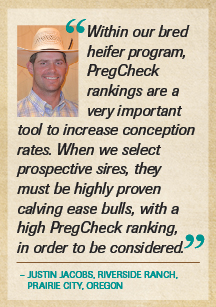
It’s that time of year again. Last year’s heifer calf crop has matured and looks great. Now, it’s time to choose a mating sire. The sire options are endless. As you study the Beef Genetic Management Guide, you narrow your selection down to two bulls. Both offer calving ease and are of the same genetic merit. Now for the tough choice, or maybe it’s not that tough. You notice Sire A has a PregCheck of 100 while Sire B has a PregCheck of 102. What does that mean again? Oh yeah, Sire B averages a 2% higher conception rate. Imagine that, 2% more pregnancies by using a sire with known fertility. 

The choice is made. Sire B it is.


Genex is proud to be the first A.I. organization to quantify individual beef sire fertility. PregCheck evaluations are the result of real breedings which have shown real differences between sires. Each bull’s PregCheck value comes with an associated reliability value. As the reliability value increases, the amount of change in the PregCheck value will decrease when additional pregnancy data are included in future analyses. For a reliable evaluation, which is about 70%, a sire must have approximately 400 breedings in the database.  


While all Genex sires are procured with producer profitability in mind, PregCheck now offers members and customers another selection option to improve their bottom lines. If you have any questions about PregCheck, please contact your local Genex representative. Your representative, is equipped with the expertise to help you put PregCheck to work in your herd!

Click here for more information on PregCheck. Feel free to leave any questions you may have on PregCheck in the comments section below.